Cuatro culturas, cuatro lenguas, un futuro


977 77 19 17
977 30 03 64
Cuatro culturas, cuatro lenguas, un futuro
977 77 19 17
977 30 03 64
The Lycée Français International de Reus is proud to announce excellent Baccalaureate results, reflecting the high quality of teaching and the personalised support provided to students throughout their schooling.
For this graduating class, the school achieved a 100% pass rate in the Baccalaureate, with 100% of students receiving honours distinctions, confirming the academic excellence of the Lycée Français International de Reus educational programme.
Among the results, 8 students obtained the Très Bien distinction (Highest Honours), including 2 students awarded with Jury Congratulations, with an overall average above 18/20. In addition, there were 8 Bien (Honours) and 5 Assez Bien (Good Pass) distinctions.
These results highlight the strength of the French international education system, as well as the commitment of the entire school community—from families to teaching staff—in supporting students’ academic and personal development.
The Lycée Français International de Reus reaffirms its mission to guide students towards academic success and access to higher education under the best possible conditions.
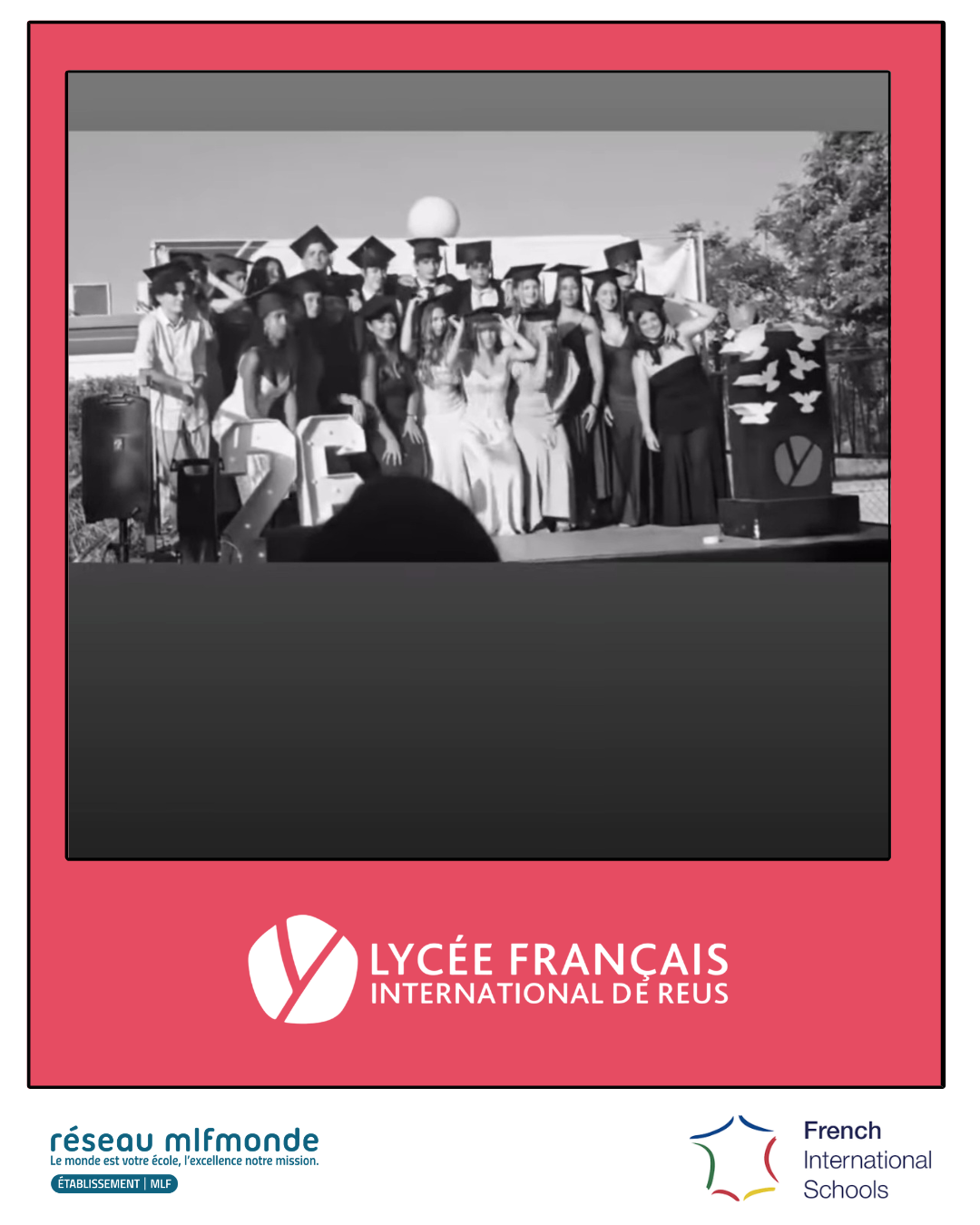
While these results reflect the academic excellence of our students, they also mark the beginning of a new stage in their lives. On the occasion of the graduation ceremony, the Headmistress addressed the students with a speech that we are pleased to share below.
Aquí tienes el discurso con la firma añadida al final de forma correcta e institucional:
Dear Graduates,
Every ceremony of this kind carries with it a certain illusion: the temptation to attribute to a symbolic moment a significance which, by itself, it cannot entirely possess.
A diploma is conferred, photographs are taken, speeches are made, and we speak of the future. We speak, too, of the passage into adulthood, as though there existed some clear threshold beyond which one suddenly becomes wiser, more responsible, more fully oneself. Life is seldom so obliging.
No ceremony, however dignified, can accomplish such a transformation in a single afternoon.
And yet ceremonies matter.
They matter because they remind us that time moves only in one direction, and that there comes a moment in every life when what has been received must begin to be repaid in the form of responsibility.
Until now, much of that responsibility has rested with others. Parents, teachers, mentors, and friends have helped to shape your judgement. They have offered knowledge, certainly, but also something more valuable: standards by which to assess the world and your place within it.
From today onwards, that burden increasingly becomes your own.
You have learned many things during your years of study. Some of them you will remember for the rest of your lives. Others will fade with surprising speed. That is perfectly normal.
The true value of education does not lie in the accumulation of information. Information has a remarkably short life expectancy. Facts change. Technologies evolve. Entire professions appear and disappear within a generation.
What endures is something less visible.
A habit of mind.
The capacity to distinguish.
To distinguish evidence from assertion.
Proof from a claim.
Truth patiently pursued from error comfortably embraced.
That, perhaps, is the deepest purpose of education.
Not to furnish us with final answers, but to make us more resistant to easy ones.
A cultivated mind is not necessarily a superior mind. It is simply a mind less vulnerable to deception.
And every age produces its own forms of deception.
Your generation will encounter them no less than any previous one.
Indeed, you inhabit a peculiar moment in history: a time in which access to knowledge has never been easier, and genuine understanding has rarely demanded greater effort.
For understanding requires patience.
It requires attention.
It requires the willingness to suspend judgement long enough for complexity to reveal itself.
Above all, it requires the humility to recognise that reality is usually more intricate than our preferences would like it to be.
Education, at its best, is an apprenticeship in complexity.
Democracy is as well.
Long before it is a political arrangement, it is a moral discipline. It requires us to live alongside those with whom we disagree; to recognise the legitimacy of perspectives not our own; to accept that a free society depends not upon unanimity, but upon shared rules.
This is why the rule of law remains one of civilisation’s greatest achievements.
Not because it is perfect.
Not because it is immutable.
But because it represents humanity’s most successful attempt to restrain power through principle.
History offers a simple lesson in this regard.
When respect for law diminishes, liberty rarely expands. More often, power merely changes hands.
And it is almost always the weak who pay the price.
For this reason, the measure of a society is found not only in its prosperity, its innovation, or its achievements, but in the manner in which it treats those who possess the least influence, the fewest advantages, and the smallest capacity to defend themselves.
Sooner or later, each of you will encounter situations in which it will be easier to remain silent than to speak, easier to conform than to dissent, easier to follow than to resist.
I am not urging you towards rebellion for its own sake. Reflexive rebellion is no wiser than reflexive conformity. I am suggesting something more demanding.
Think.
And having thought, accept responsibility for the conclusions to which thought has led you.
Even when those conclusions place you in a minority. Even when they leave you standing alone.
Dante’s famous injunction to pursue “virtue and knowledge” is often understood as a celebration of learning. It is that. But it is also something more.
Knowledge alone is never enough.
The twentieth century demonstrated, with tragic clarity, that highly educated people are perfectly capable of moral blindness.
This is why knowledge must be accompanied by judgement.
By character.
By a sense of obligation towards something larger than oneself.
Otherwise, knowledge becomes merely technique.
And technique, like every tool ever devised, can be used equally well to build or to destroy.
Many of you will enter professions that scarcely exist today. Some will lead organisations. Others will teach, innovate, heal, govern, create, or raise families.
The skills required of you will change repeatedly throughout your lives.
What must not change is the purpose to which those skills are directed.
For the central question is not whether one is capable of doing something.
It is whether one ought to do it.
And for whose benefit.
Perhaps that is where adulthood truly begins: at the moment when one’s abilities cease to be merely personal assets and become responsibilities owed to others.
Allow me, then, to conclude with a wish.
Not success. Success is a poor measure of a life, though our age often mistakes it for the highest one.
I wish you something rarer.
I wish you intellectual restlessness.
The refusal ever to consider your education complete.
The habit of continuing to read when others cease to do so.
The habit of continuing to learn when no examination requires it.
And the preservation of an inner territory of freedom in which fashion, interest, and fear are never permitted the final word.
If you can preserve that territory, then whatever profession you pursue, whatever path you choose, you will have retained the finest part of what education sought to give you.
And perhaps, in doing so, you will leave the world not merely more prosperous or more efficient, but a little wiser, a little freer, and a little more just than you found it.
Mme Stallini
Headmistress of the Lycée Français International de Reus